


July 29, 2026
News

Two US Troops Killed and One Missing After Iranian Attack in Jordan

  • July 18, 2026
  • 0

Read the latest updates on the Iranian attack in Jordan that left two U.S. troops dead and one missing. Explore the attack, rising U.S.-Iran tensions, military response, and
Two US Troops Killed and One Missing After Iranian Attack in Jordan

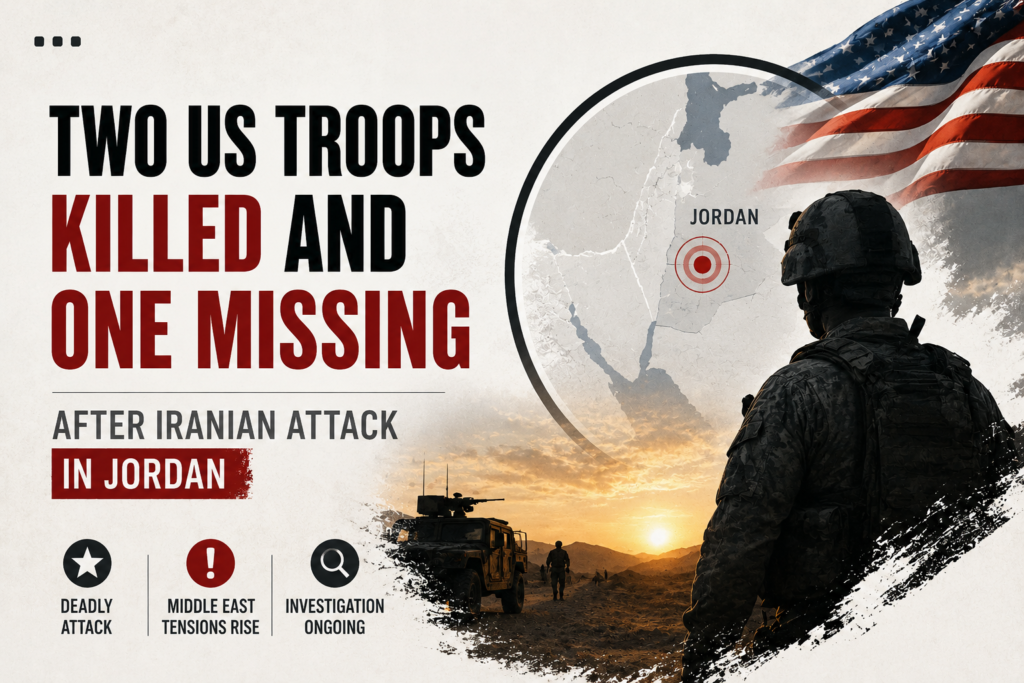
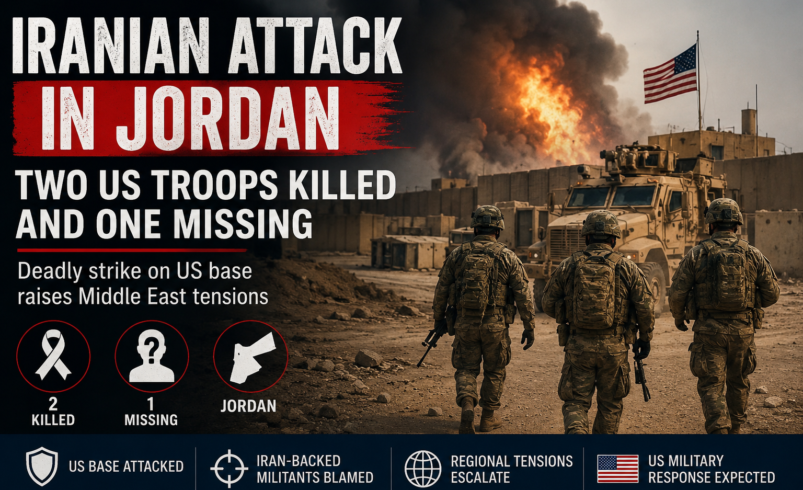
The deadly Iranian-backed attack in Jordan has intensified fears of a wider conflict across the Middle East, marking one of the most significant attacks on U.S. military forces in recent years. The strike targeted a remote U.S. military outpost near the Jordan-Syria border, resulting in the deaths of two American service members, while one additional soldier remains missing. The incident has heightened tensions between the United States and Iran, prompting urgent discussions among military leaders and government officials over the appropriate response. As investigations continue, the attack has sparked international concern about regional stability, the safety of deployed troops, and the possibility of further military escalation that could draw additional countries into the growing conflict.

The Deadly Attack

According to initial military reports, the attack occurred during the early morning hours when the U.S. base in Jordan was struck by what officials believe were Iranian-backed drones and missiles. The surprise assault caused significant destruction to military infrastructure, damaged defensive equipment, and forced emergency response teams into immediate action. Despite advanced security measures, the strike resulted in the tragic deaths of two U.S. troops, while search-and-rescue operations continue for the missing American service member. Several additional personnel reportedly sustained injuries ranging from minor wounds to critical conditions, highlighting the devastating impact of the coordinated assault.

Rising U.S.–Iran Tensions

The attack represents another dangerous chapter in the long-running confrontation between the United States and Iran. American officials have accused Iran-backed militant groups operating throughout the region of carrying out repeated attacks against U.S. military installations in Iraq, Syria, and Jordan. Although Iranian officials have frequently denied direct involvement in such operations, U.S. intelligence agencies continue to argue that these armed groups receive financial support, advanced weapons, and military training from Tehran. The latest strike has renewed calls in Washington for stronger defensive measures and a firm response designed to deter future attacks against American forces stationed overseas.

Search for the Missing Soldier

Military officials continue an extensive search-and-rescue mission to locate the missing American service member. Specialized rescue teams, surveillance aircraft, drones, and intelligence units have been deployed across the surrounding desert region to determine the soldier’s whereabouts. Defense officials have stated that every available resource is being used in the operation while family members remain informed of developments. The uncertainty surrounding the missing troop has added emotional weight to an already tragic event, with military leaders expressing hope that rescue efforts will lead to a successful recovery.

International Response

World leaders have expressed deep concern over the attack, warning that further escalation could threaten peace throughout the Middle East. Several allied governments have condemned the violence while urging restraint to prevent a broader regional conflict. International security experts believe that any direct military retaliation by the United States could significantly increase tensions, potentially involving additional armed groups and neighboring countries. Diplomatic efforts are continuing behind the scenes as global leaders attempt to reduce the risk of a larger confrontation.

Potential Military Response

The U.S. Department of Defense is reviewing multiple response options, including targeted strikes against militant facilities believed to be responsible for planning the attack. Senior military commanders have emphasized that protecting American personnel remains the highest priority and that any response will be carefully coordinated to avoid unnecessary escalation while demonstrating that attacks on U.S. service members will not go unanswered. Intelligence gathering has also intensified to identify those directly responsible and prevent future threats against American forces stationed across the region.

Broader Regional Impact

Security analysts warn that the attack could have lasting consequences beyond the immediate military response. Increased instability in Jordan, Syria, and neighboring countries may disrupt regional security cooperation, humanitarian operations, and international diplomatic initiatives. The incident also raises concerns about the growing use of armed drones, precision-guided missiles, and asymmetric warfare by non-state militant groups, making military installations more vulnerable despite sophisticated defense systems. As tensions continue to rise, governments worldwide are closely monitoring developments that could reshape the security landscape of the Middle East.

Conclusion

The deaths of two U.S. troops and the disappearance of one American service member following the Iranian-backed attack in Jordan represent a serious escalation in the ongoing regional conflict. As rescue operations continue and investigations seek to determine responsibility, the international community faces growing uncertainty over what comes next. Whether through diplomacy or military action, the decisions made in the coming days will likely influence the future of U.S.–Iran relations, regional security, and the broader stability of the Middle East for months and possibly years to come.

Leave a Reply

Your email address will not be published. Required fields are marked *